2142 stories
·
2 followers

Who started Nollywood?

1 Share

Here is the short version of a story that has been told wrong for 30 years.

Kenneth Nnebue was born in Mgbidi, Imo State. He left school after sixth grade and apprenticed under his brother, a handbag maker, before entering trade himself in the Onitsha market. By the late 1980s, he was in Lagos, importing VHS tapes from Taiwan, distributing pirated foreign films, and trying to move product in a difficult economy. When the tapes stopped selling, he put an original story on them instead. That story — Living in Bondage (1992) — cost 150,000 naira, about $7,000 at the time. It sold over 100,000 copies in its first weeks through informal markets in Lagos, Enugu, and beyond. It launched a global industry.

What gets left out of most tellings: before Nnebue made Living in Bondage in Igbo, he had already produced at least 27 Yoruba-language films. An Igbo trader, operating in Lagos, making Yoruba content, who then made the Igbo film the world decided was the beginning of everything. The ethnic ownership of that origin — who gets to claim Nollywood, which tradition gets the credit, which city gets the heritage tourism — has been contested ever since. Not because the evidence is unclear, but because resolving it requires someone to say plainly what Nollywood actually is: an art form rooted in Yoruba theatrical tradition, or an industry born from an Igbo trader’s logistics problem. These are different things. The confusion between them is not innocent.

The Yoruba side of the argument is not a retroactive claim. The Yoruba Traveling Theater tradition, Alárìnjó, reaches back to the 19th century. Its modern form is usually traced to Hubert Ogunde, whose touring theater company toured Nigerian cities through the 1950s and 1960s, its work politically sharp enough that a regional premier banned it outright. That stage tradition migrated to celluloid film through the 1970s and 1980s, and by 1985 Moses Olaiya’s Mosebolatan was one of the country’s first genuine blockbusters. Critically, Yoruba filmmakers moved onto VHS format in 1988, four years before Living in Bondage. If the question is who touched the video format first, it wasn’t Nnebue.

So why does his name carry all the credit? Because Living in Bondage wasn’t first, but it was the first to look like it knew what it was doing, packaged with a glossy, full-color cover styled after pirated Hollywood tapes, presented as a professional product instead of a stopgap. The story helped too — a man who joins an occult society and sacrifices his wife for wealth, only to be haunted by what he’s done — landed hard in a country deep in structural adjustment-era desperation, when stories of ritual money were part of the cultural air people breathed. And despite being shot entirely in Igbo with no subtitles for a full year, the film crossed ethnic lines anyway — co-producer Okey Ogunjiofor would later say simply that people who didn’t understand the language still understood the story, because the pictures carried it.

What Nnebue actually contributed, then, wasn’t the invention of video filmmaking — Yoruba practitioners had that four years earlier. He contributed a “template,” an industrial model of direct-to-video production that the entire industry would replicate for the next two decades. Every straight-to-video Nollywood film that followed, regardless of language, was built on the business logic Nnebue stumbled into while solving an unglamorous warehouse problem.

Laid side by side, these two histories aren’t actually contradictory; they’re answering two different questions. It’s the single phrase “who started Nollywood” that collapses them into one, forcing a false contradiction. The Yoruba lineage answers where the art form came from. The Nnebue story answers where the industry came from. Ogunde’s company built the grammar. Nnebue’s warehouse problem built the factory.

I’m writing this from Enugu, one of the cities where Living in Bondage first sold by the hundreds in market stalls. Here, Nollywood’s Igbo roots aren’t distant history but lived memory, passed down the way a family recipe is. That memory is real. So is Ogunde’s banned theater company. Neither one needs to lose for the other to be true.

But Nigeria rarely lets cultural origin stay this generous. Who started Nollywood is never just a historical question here — it’s tied to tourism revenue, festival programming, whose language gets state funding, whose grandchildren get to say “we built this.” Thirty years on, the debate hasn’t been resolved because resolving it was never really the point. Someone benefits from the ambiguity every time it stays open, and someone loses something every time it closes.

That, more than the biography of one trader from Mgbidi, is the story worth telling.

Read the whole story
koranteng
1 hour ago
reply
Share this story
Delete

Only Interests

1 Share
Bureaucratic maneuvering born of sharp elbows
Directing the ultimate operational examples
We have only interests and shades of gray

So. Thoroughly flesh out the preferred option
While presenting limp policy alternatives
These fig leaves adorn the poisoned chalice
We have only interests, it's worth the price we pay

Constructing straw men in this intellectual game
Realpolitik when it comes to brass tacks
A balancing act of supposed hard choices
We have only interests, tough decisions have to be made

Deflection, play down the issue of an embargo
Encourage accommodation and liberal treatment
Throughout, proffer expressions of sorrow
We have only interests come what may

Moral blinders in the form of dual purpose equipment
Facade of toothless sanctions against de jure illegality
Exchange programs in all categories, including military
We have only interests, suffice to say

As to the unfettered pursuit of power and wealth
Cynical calculation asserting favored preferences
The strange architecture of misdirection
We have only interests, the decisions have been made


Ebony August 1976 Kissinger in Africa


After National Security Study Memorandum 39 And The Future Of United States Policy Toward Southern Africa by Edgar Lockwood


File under: , , , , , , , , , , , , ,

Writing log: May 24, 2023

Read the whole story
koranteng
3 days ago
reply
Share this story
Delete

Why Lesotho’s remittance ‘safety net’ was never really its own, and why it is failing again in 2026

1 Share

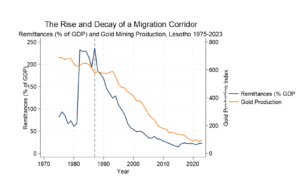
Lesotho is two years into a national state of disaster: US tariffs have gutted its garment factories, unemployment has passed 30%, and its main trade lifeline is guaranteed for less than a year. To understand how the mountain kingdom keeps ending up here, start almost forty years earlier.In 1987, something extraordinary happened in this small kingdom, completely surrounded by South Africa. Money sent home by Basotho men working in South African gold mines reached 236% of Lesotho’s entire GDP. Not 23%. Not 60%. More than double the value of everything the country itself produced in a year. Today, that figure sits at around a fifth of GDP. The money didn’t slow down gradually. It collapsed, and it has never recovered. To understand why, you have to understand what that money actually was.

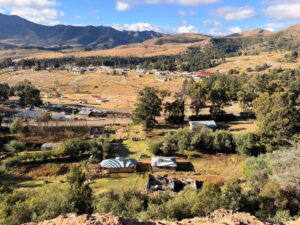
A mountain village in Lesotho.

Why one country’s economy ran on someone else’s mines

For over a century, Lesotho had almost no domestic industry of its own. What it had instead was proximity: a small, mountainous, landlocked territory sitting right next to the richest goldfields on Earth. South African mining houses needed enormous numbers of workers willing to do dangerous, underground labour for low pay, and they built an entire recruitment system to draw men from Lesotho, in their hundreds of thousands, to fill that need.

This wasn’t diversification. It was concentration. An entire national economy came to depend not on a sector but on the hiring decisions of one industry, in one neighbouring country, that Lesotho had no ownership of and no influence over. The arrangement generated enormous sums of money. But it meant Lesotho’s prosperity was never really Lesotho’s to control. It belonged to the price of gold, the depth and cost of South African ore bodies, and the mining houses’ own calculations about profitability: decisions made in boardrooms far from Lesotho.

Why the mines emptied out

South Africa’s gold mining industry has been declining for decades. Ore grades have thinned, extraction has moved ever deeper and more expensive, and profitability has steadily eroded. Industry data shows gold mine employment falling from around 536,000 workers in the late 1980s to roughly 94,000 in 2023, a loss of more than 440,000 jobs. What is far less well understood is when that decline first showed up on the ground in Lesotho. That is what our research set out to trace.

The illusion of insurance

Here is the idea we set out to test, in ongoing research that is not yet peer-reviewed: a common assumption in development economics holds that remittances act like insurance for vulnerable countries. When disaster strikes at home, such as a drought or a bad harvest, the theory goes, migrant workers send extra money to cushion their families. It appears again and again in World Bank reports and climate-adaptation policy documents. If it were true anywhere, it should have been true in Lesotho. So we tested it every way we could think of: immediate effects and delayed ones, good mining years and bad, average years and the very worst.

So far, we have found nothing. At no point did Lesotho’s own climate conditions appear to move the money flowing into the country. This work is ongoing. But that absence is the whole point. Real insurance responds to your shocks: your drought, your bad year. What Lesotho had was money that moved in response to conditions entirely outside its own borders. That isn’t insurance. It’s exposure to a risk you don’t control, wearing the appearance of a safety net.

What the sequence suggests, and what it does not prove

Our analysis cannot show that the mining industry’s decline directly caused Lesotho’s remittance collapse. Establishing causation from national data alone is genuinely difficult, and we want to be honest about that limit. What we can show is a sequence, dated using statistical tools that detect when a long-running trend breaks.

Net migration out of Lesotho reversed course in 1986: families were already pulling back from the mines before anything else in the data moved. Just two years later, in 1988, around the same time mine employment across the industry peaked before its long decline, Lesotho’s remittances began their long, uninterrupted fall. It would be a full decade, until 1998, before international aid to Lesotho showed any measurable shift. That was also the year of Lesotho’s post-election crisis and SADC intervention, so donors may have been answering the political emergency; either way, aid moved ten years after the money did. And South Africa’s own gold production statistics did not formally register a structural decline until 2004, sixteen years after Lesotho’s remittances had already begun falling.

That gap matters. Ordinary households were responding to what was happening in the mines well before it showed in industry figures, and years before aid responded. We treat this as a striking, dated pattern worth taking seriously, not proof of a single mechanism.

The navy line tracks remittances as a share of Lesotho’s economy; the orange line tracks South African gold mining output; the vertical dashed line marks the 1987 remittance peak. Both series trend downward over the long run, though their statistical turning points sit sixteen years apart (1988 and 2004). The closer, two-year link we found is between Lesotho’s own migration reversal (1986) and its remittance collapse (1988). Data: World Bank (remittances); South African Reserve Bank (gold production). Chart: authors.

The sequel is playing now

If this were only history, it would be warning enough. But Lesotho is living the sequel. After the gold remittances collapsed, the country rebuilt its external lifeline around textiles: garment factories serving American brands under the African Growth and Opportunity Act (AGOA), which became the country’s largest private employer. Then, in April 2025, the United States imposed steep tariffs on Lesotho’s exports. Orders from American buyers dried up, factories cut shifts or closed, and the government declared a two-year national state of disasteras unemployment passed 30%. The 2026 renewal of AGOA guarantees market access for less than a year, so orders remain cautious and investment is on hold.

Swap Johannesburg’s gold for Washington’s tariffs and the structure of the story is identical. An economy leans its external income on an industry it neither owns nor controls, located in, or dependent on, someone else’s country. Decisions taken far away determinewhether Basotho households eat. The mechanism is the same one, wearing different clothes.

Why this matters beyond one small country

It would be easy to read this as a specific, unfortunate story about Lesotho. It isn’t. It’s a warning about an assumption embedded in much development thinking: that migration and the remittances it generates are a durable form of resilience a vulnerable country can lean on.

Individual families may well cushion each other when disaster strikes; household studies elsewhere have found exactly that. But the version of this idea that matters for policy is the national one, and Lesotho was the strongest possible test case, and so far it fails. Its remittances never moved with Lesotho’s own climate shocks. And when the broader system they depended on began to weaken, there was no cushion, because there had never really been one built at home. There was only ever a single foreign employer, and an economy that had quietly organised itself around never asking what would happen if that employer changed its mind.

For Lesotho, whose garment workers are today learning the lesson its miners’ families learned forty years ago, and for the many other economies whose fortunes are tied to a single foreign industry or a single migration corridor, that is the real lesson: a safety net that depends entirely on someone else’s decisions was never a safety net to begin with. It was a bet, one an entire country made without ever quite realising it had.

The post Why Lesotho’s remittance ‘safety net’ was never really its own, and why it is failing again in 2026 appeared first on African Arguments.

Read the whole story
koranteng
10 days ago
reply
Share this story
Delete

Trouble Manufacturers

1 Share
Trouble manufacturers, all competitor coupons happily accepted
We are never knowingly undersold, you've, no doubt, heard our enduring promise
Our prices are insane, truly, nobody beats us
For trouble is our business. Satisfaction guaranteed

The future of anxiety retail is moving in our direction
Extra discounts on distress will be applied when you check out
Rest assured, our no pressure tactics are world renowned
And if all else fails, consider our money back guarantee

Worry on demand, cash on delivery
A legendary family-owned business
Take part in our award winning retail experience
Premium service for all, pricing you can understand
Trouble manufacturers
Affordable luxury each and every day


contact the miracle prophet


Trouble, a playlist


A soundtrack for this note (spotify version) File under: , , , , ,

Writing log: May 21, 2023

Read the whole story
koranteng
11 days ago
reply
Share this story
Delete

Now's the Time

1 Share
The afterlife of a whispered thought
Lingering, a seed planted haphazardly bears fruit
Precious, a leaf collects dew drops, a matter of flows redirected
Reducing, harnessing, fluid dripping capturing the very essence

Even without anyone immediately acting, ideas witnessed gain weight
Assessed when issued but always waiting for their moment
That nature and society abides with the waiting without regret
Secure in the gods' admonition for restraint
Keenly discerning the theme that opportune time deems befitting
When mankind would seize the direction of the most worthy

The prescient would bemoan the wasted time
While the laggards, new converts all, would sing the praises of the present
The regrets of the former - inconvenient as they are,
Are mere reminders of the grand experiment that is life

Pressure relieved, catharsis reprieved
The rhythms echo the past messages
Fragments made whole, a new synthesis
Vivid futures in prospect, now's the time


Dew drops by Gabriele Schwibach

Now's the Time, a playlist


A soundtrack for this note. (spotify version) File under: , , , , , ,

Writing log: May 21, 2023

Read the whole story
koranteng
24 days ago
reply
Share this story
Delete

The Coup Costs More Than the Corruption It Claims to Fix

1 Share

Since 2020, soldiers have seized power in Mali, Guinea, Sudan, Burkina Faso (twice), Niger, and Gabon. In every case, the announcement has followed the same script: corruption has hollowed out the state, civilian government has forfeited its legitimacy, and the military is stepping in to restore what politicians destroyed. Crowds have gathered to celebrate in Bamako, Conakry, Ouagadougou, and Niamey, believing that the promise on offer, cleaner government, was one worth the risk.

Sixty-five years of data, from 1960 to 2024, tracking all 222 coup events, successful and attempted, across 53 African countries say the promise has never been kept. Worse: coup governments do not merely fail to fight corruption. They make it worse, systematically, every time.

Across 53 African countries from 1996 to 2024, each additional successful coup a country experienced was associated with a measurable decline in the World Bank’s Corruption Control index, not an improvement. When we instrument for the possibility that corrupt countries are simply more coup-prone to begin with, rather than coups causing the corruption, the relationship survives and strengthens: the instrumented estimate is larger than the raw correlation, not smaller. This is not the pattern a genuine anti-corruption intervention would produce.

A coup by Assimi Goïta in Mali in 2021 inaugurated a wave of coups across central Africa in the Sahel.

A coup by Assimi Goïta in Mali in 2021 inaugurated a wave of coups across central Africa in the Sahel.

The mechanism is not mysterious. A coup’s first act is to suspend the institutions that would have caught the corruption it claims to be fighting: the courts, the legislature, the press. The commissions and prosecutions that follow in the coup’s first weeks are real, but they operate inside an institutional vacuum that the coup itself created. There is no independent judiciary left to enforce anti-corruption law without executive interference, no free press left to expose what the new government would rather hide, no legislature left to scrutinise the budget. A government cannot use institutions to fight corruption after it has dismantled the institutions.

The costs compound beyond governance. The same dataset shows a GDP growth shock of roughly 4 to 5 percentage points in the year of a coup, consistent across three independent identification strategies. Debt burdens rise. Human development stalls: countries with no coups since 1990 show statistically significant convergence toward the rest of the world on the UN’s Human Development Index; the most coup-affected countries show none. The gap between a country’s most stable and most coup-prone paths is not narrowing. It has been widening for three decades.

And the coups compound on each other. Among African countries that have experienced one successful coup, roughly seven in ten go on to experience a second. After a second, the recidivism rate rises further. The median time to the next coup shortens with each successive coup. Part of this trap runs through the same institutional and economic damage described above, though the evidence for that mechanism is real without being total: a purely economic-and-institutional model meaningfully outperforms random prediction, but does not come close to fully explaining which country falls into a repeat coup and which does not. Something else, – possibly regional normative diffusion, possibly military organisational culture – is also at work, and our research is continuing to seek to measure and isolate these further variables.

What we do know is where the counterfactual sits. Nine African countries have had no successful coup since 1990: Botswana, Cabo Verde, Ghana, Kenya, Mauritius, Namibia, Senegal, South Africa, and Tanzania. They span different income levels, colonial histories, and political systems. What they share is uninterrupted institutional continuity, decades in which courts, elections, and a free press kept operating, imperfectly, without being reset to zero. Mauritius and Botswana are now among the best-governed states on the continent by any measure. Ghana crossed from negative to positive on the World Bank’s corruption index only after 43 years without a coup. That is not a coincidence. Institutional accountability, like capital, compounds; a coup is the one event guaranteed to interrupt the compounding.

This has a direct implication for how the international community responds to the current wave. Anti-corruption rhetoric from a coup government is not a signal that engagement on governance reform is safe to resume. It is, on the evidence, close to the opposite: the very absence of the institutions needed to make that reform real. Conditionality tied to the restoration of courts, press freedom, and electoral competition, not to the announcement of an anti-corruption commission a coup government fully controls, is the response the data actually support.

None of this is an argument that civilian governments in Africa have been well governed, or that their corruption was invented by their critics. It is an argument about what replaces them. The choice a coup offers is never between corrupt civilian rule and clean military rule. It is between imperfectly accountable government, capable of incremental correction, and unaccountable government, in which there is no longer a mechanism left to correct anything. Citizens who welcome a coup in the sincere hope of cleaner government are making a bet that three decades of evidence, from dozens of countries, have already decided against them.

The post The Coup Costs More Than the Corruption It Claims to Fix appeared first on African Arguments.

Read the whole story
koranteng
25 days ago
reply
Share this story
Delete
Next Page of Stories