The subtle art of divination
A gift lost in the mist of time
From gods that would teach lessons about how to see
A sense of clarity forgone early on in our encounters
Thus only an uncertain few walked among us
Finely attuned as they were to this external music
Responding to talking drums that others could barely perceive
The rumbling sounds most merely mistook for background noise
Underlying conditions then,
Fragments these liminal invitations
The message was always there,
Just listen, they would advise
And the messages were received
For the soothsayers paved the way
...
That the frayed threads were pulled together
For a people that only looked outwards
That a reflection was there to be seen
If only one paid attention to the stories told
Disconcerting perhaps in the light of day
They faced a better reception once night fell
But were ever mindful that tired senses would then pertain
That the textures were woven, witness the emergent fabric
Prophecy is a thankless task
Even when couched with the best intentions
For the bearer, despite themselves, implies a need for change
That still they persisted, indeed for them it was a compulsion
Caution, take heed, they said.
The soothsayers pursued their mission
They tell me talk is cheap. But is it, really? Even chatting with a bot nowadays can involve a hefty subscription fee. And there are plenty of human professionals, from counselors to consultants, whose conversations also come with a price tag.
Let’s talk—but first give me your credit card number….
Yes, everywhere I look talk is expensive. Even the scammers who carpet bomb my phone now rely on recorded messages, adding insult to injury—you know it’s bad when con artists are too busy to talk to us. I guess if you want cheap talk nowadays, you’re advised to talk to yourself, like Robert De Niro on a bad hair day.
I’d rather live in a different kind of world—one where dialogue is priceless and conversation is celebrated as a source of human connection. As such, it deserves our protection and respect. When we stop speaking to each other, we soon start warring. Our better nature descends to the bestial.
In that spirit, I’m showcasing the greatest hits in the history of conversation. It has an illustrious lineage, traced back to the divine—and was the originating gift that made all society and its benefits possible.
Here are the 42 milestone moments, as I see them.
Please support my work—by taking out a premium subscription (just $6 per month).
900 BC: The first texts of Judeo-Christian scripture portray God in frequent conversation with humans.
God, in these texts, speaks directly with people—sometimes in flamboyant ways (from a burning bush, on a mountaintop) but with total immediacy. This happens less often in later scripture, but creates a lasting tradition of prayer and intercession where the divine is accessed in intimate conversation.
500 BC: Greek tragedy introduces the dialogue, changing a sacrificial ritual into public entertainment.
The Greek dramatist Aeschylus changes the rules of theater—allowing characters to talk to each other onstage. Previously they only spoke to the chorus. Conversation now serves as a cornerstone for public storytelling.
400 BC: The Socratic dialogue creates turmoil in Athens.
Socrates introduces the idea of teaching philosophy via conversations. But the authorities are always suspicious of open discussions of this sort. So Socrates gets accused of corrupting the youth, and is executed. But his student Plato turns the Socratic dialogue into the building block of Western philosophy.
350 BC: Aristotle writes a treatise on rhetoric—legitimizing the use of speech and conversation to persuade.
Plato had tried to discredit sophistry and rhetoric as tools of persuasion—he valued the truth higher than these speaking techniques. But Aristotle writes a book on rhetoric, and establishes it as a core part of Western education.
81 BC: The Discourses on Salt and Iron shake up the Chinese economy.
After the death of Chinese Emperor Zhao of Han, the regent Huo Guang invites leading scholars to the imperial court to hold a debate on economic policy. This is an important milestone in the history of open societies. Decisions are made after a give-and-take, and thus can draw on the best ideas, regardless of their source.
100 AD The Gospel of John identifies the divine source of creation with the logos or word.
It’s one of the best known—and opaque—claims in the Gospels: “In the beginning was the Word, and the Word was with God, and the Word was God.”
610: Muhammad receives the first revelation of the Koran in dialogue with the archangel Gabriel.
While secluded in a mountain cave, Mohammad has a vision of the archangel Gabriel, who engages in discourse and teaches him to recite holy scripture. They continue this conversation for the next two decades.
800: Female slave singers during the Abbasid Caliphate are prized for their conversational skills—and sometimes talk back haughtily to powerful people.
The female slave singers of the Arabic world, known as qiyān, enjoy liberties that most free women can’t match at the time. They can move about in public without covering their faces. They can wear colorful outfits. And they are celebrated for their banter—so much so that they often talk back to their owner.
They also set a precedent for the later evolution of the love song in Europe (see below).
1200: Female troubadours (or trobairitz) introduce a more conversational style of love song into France.
The male troubadours developed a more stylized and idealized approach, but their female counterparts prefer a direct, conversational tone. This is a turning point in the history of song as a source of self-expression.
1516: The quotation mark appears for the first time in a published book.
Printer Mathias Schurer boldly introduces a new punctuation mark in his edition of Philostratus's De Vitis Sophistarum. Schurer put these paired inverted commas at the start of each line of quoted text.
There’s some irony in the fact that this book is a guide to sophistry—precisely the kind of discourse that Plato hated so fervently and tried to counter with his dialogues.
This is what quotation marks looked like 500 years ago.
1600: The talkative sidekick is invented.
At almost the same moment, the two greatest creative minds in Europe invent the concept of the sidekick—a talkative and sociable companion to the story’s hero. Cervantes gives Sancho Panza this role in Don Quixote, and the banter never stops. Shakespeare does something similar with Falstaff, who plays the role of entertaining drinking companion to Prince Hal in his history plays.
This character type was unknown in ancient tragedy or Grail legends or epic poetry. All future sidekicks in entertainment—Robin for Batman, McMahon for Carson, Watson for Sherlock, Chewbacca for Solo—build on these late Renaissance innovations.
Mid 1700s: Debating societies come out of hiding, and become popular entertainment in London.
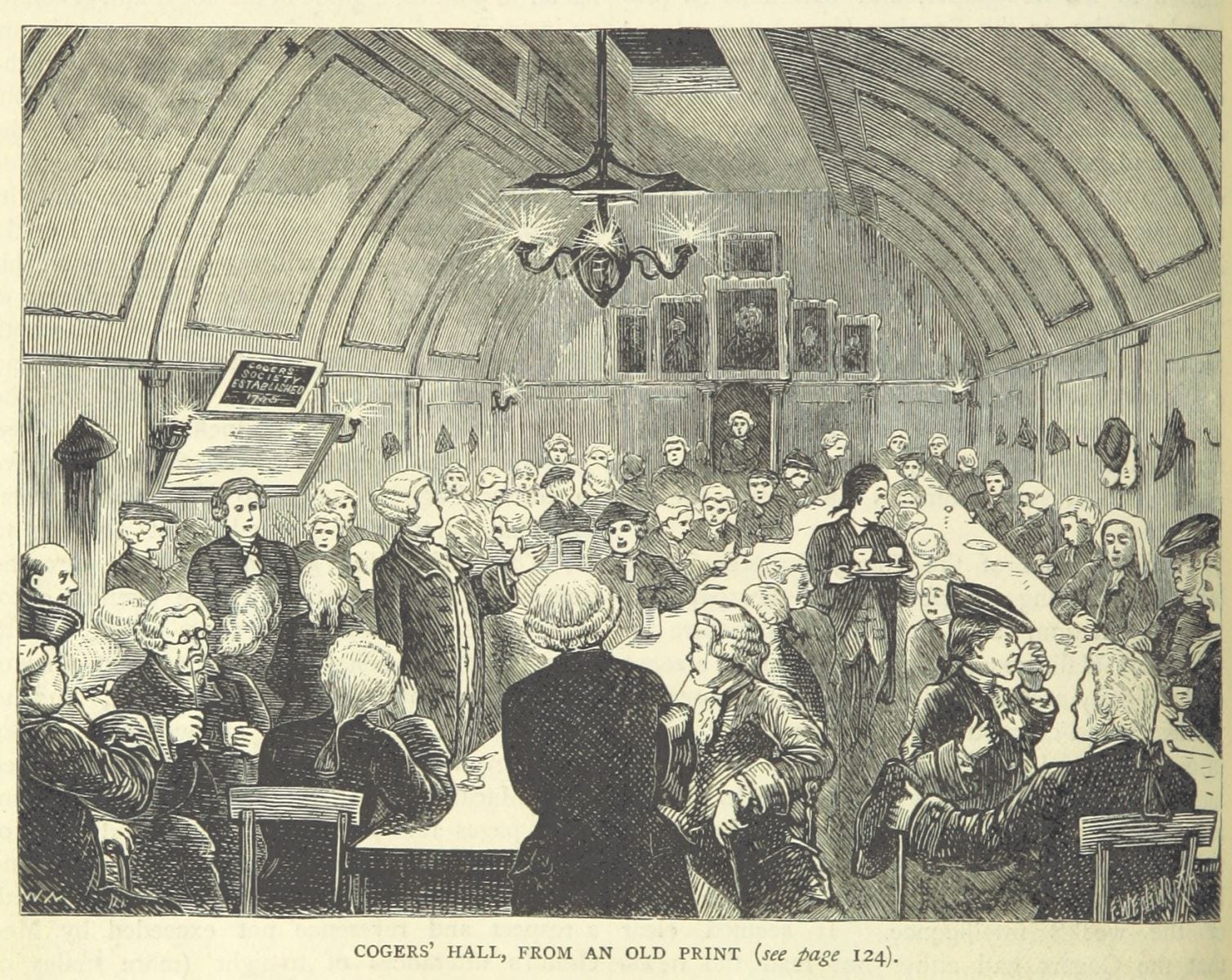
The first debating societies in England operated in secret—because free speech is always dangerous. But during the middle of the eighteenth century they come out in the open and play a key role in supporting democracy. The Society of Cogers, founded in 1755, still operates today—and is the oldest debating organization in the world.
1789: The US Bill of Rights establishes freedom of speech in its very first sentence.
In a radical move with long-lasting implications, the Bill of Rights declares that the government cannot make a law “abridging the freedom of speech, or of the press, or the right of the people peaceably to assemble, and to petition the Government for a redress of grievance.”
1789: Political clubs play a key role in the French Revolution—and spread all over the country.
The French Revolution was fought as much with words as weapons, and political organizations such as the Jacobin Club served as forums where conversation easily turned into action. The clubs were popular all over the country, and served as launching pads for political parties.
1858: The Lincoln-Douglas debates define the future of American democracy.
In a strange quirk, the two candidates for Senator from Illinois would compete again for the presidency two years later. Their seven early debates address all the divisive issues of the era, especially slavery. Thousands of people attend and listen attentively for hours as the two candidates parleyed back and forth. American politics has rarely matched this level of open, unfettered exchange in subsequent years.
1876: The first phone conversation in history is a short one.
Alexander Graham Bell demonstrates his new invention by talking to his assistant Thomas Watson over the phone. His brief message was: "Mr. Watson, come here. I want to see you.” But doesn’t that defeat the whole purpose of the phone?
1901: Freud explains the Freudian slip.
In his book, The Psychopathology of Everyday Life, Freud explains that the mistakes we make while speaking reveal the inner workings of our psyche. “The thoughts outside the intended speech,” he explains “determine the origin of the speech-blunder, and also suffice to explain the newly formed mistakes in speech.”
1903: Henry James writes a novel—The Ambassadors—in which almost every conversation hides multiples levels of unspoken agendas.
The Ambassadorsis destined to become a famously difficult book, feared even by the bravest grad students today. But it reaches a new level in the psychological novel, and shows how much remains unsaid even when we speak our mind. Joel Miller, in a recent Substack analysis, identifies six different levels of meaning in the conversations presented in this book.
1906: The first covert listening device is patented in the US.
Kelley M. Turner patents the first bugging device—with a microphone in one location connected to a speaker in another. The listener has the option of preserving the bugged conversation on a record. This device was embraced by law enforcement, launching a never-ending practice of surveillance of private conversations.
1915: T.S. Eliot ridicules ‘serious’ conversations.
“In the room the women come and go,” he writes. “Talking of Michelangelo.” The modernist debunking of conventional highbrow culture has now begun in earnest.
1919: Arthur Crew Inman pays people to talk to him—and turns it into the 177 volumes (now in Harvard Library).
Was Inman crazy or brilliant—or maybe just creepy? As a young man, he started paying total strangers to come to his house and tell him stories about their lives. He wrote these down in voluminous diaries—a brutally honest account of 20th century Americn life featuring more than 1,000 characters. Harvard later acquired the diaries and published extracts in two volumes.
1927: The introduction of the “talking movie” changes the course of modern entertainment.
As soon as the public had a taste of the “talkies” everything changed in Hollywood. All the studios embraced the new technology, and movie theaters did the same. Before the end of the decade, the changeover was complete.
1928: In Eugene O’Neill’s Strange Interlude, characters on the stage talk to the audience.
This experimental play broke many rules, but gained particular notoriety for its direct address to the audience. Many mocked this maneuver, but it didn’t prevent O’Neill from winning the Pulitzer Prize for Drama.
1930: The Marx Brothers turn Strange Interlude into a joke.
Groucho Marx pokes fun at Eugene O’Neill by inserting direct-to-the-audience interludes in his comedy film Animal Crackers. At one point he says: “If I were Eugene O'Neill, I could tell you what I really think of you two.”
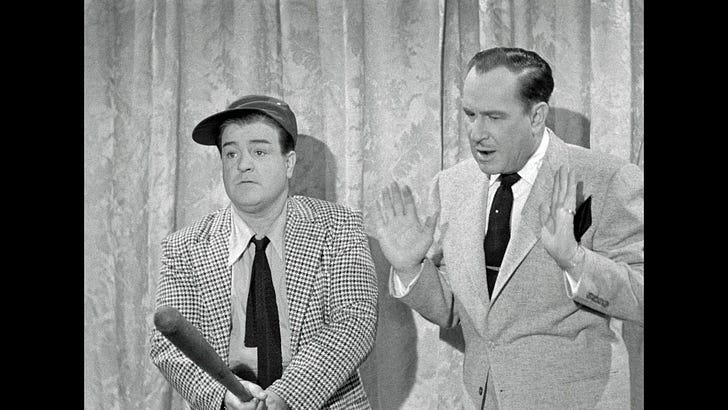
1937: Abbott and Costello have a breakout success with “Who’s on First?”
Time magazine later claimed this is the greatest comedy skit of the 20th century—and for once they got something right. It’s based on a simple failure of communication during a discussion of baseball.
1950: Alan Turing invents the Turing Test—which judges artificial intelligence on its ability to hold a plausible conversation.
In his 1950 paper “Computing Machinery and Intelligence,” Alan Turing decides that the best way to decide whether a machine can think is to engage it in conversation. Drawing on an argument that resembles the old “if it quacks like a duck” meme, he decides that if a machine can converse like an intelligent being, it is an intelligent being.
1951: Carl Rogers introduces a new method of non-confrontational dialogue.
In his paper “Communication: Its Blocking and its Facilitation” (1951), Rogers offers a new method of conversation that reduces tension and friction. In this approach, he begins each response by summarizing what his interlocutor just said.
“Each person can speak up for himself only after he has first restated the ideas and feelings of the previous speaker, and to that speaker’s satisfaction,” Rogers explains. This technique, he claims, reduces antagonism and builds empathy.
This Rogerian approach becomes a powerful technique in therapy, but also in negotiations and other contexts. His technique later contributes to the design of chatbots (see entry on ELIZA below).
1951: The first TV talk show is introduced in New York.
Broadcaster Joe Franklin has a wild idea—why doesn’t he just sit in front of a TV camera and talk to people. He convinces WJZ-TV (later WABC-TV) to put this low-cost entertainment on the airwaves. The format catches on and spreads everywhere. NBC launches The Tonight Show four years later.
1960: Kennedy faces Nixon in the first televised US presidential debate.
For the first time in history, the two candidates for the Oval Office face off in a televised debate—the first of four encounters between these political opponents. The verdict of history is that Nixon lost because he looked nervous and less telegenic. He probably had the same view—judging by the fact that Nixon refused to do debates when he ran again for president in 1968 and 1972. But in subsequent years, these televised jousts have served as an essential part of US democracy.
1966: Simon & Garfunkel record “The Dangling Conversation.”
Released in the Summer of 1966, this song presents a dialogue at cross purposes (“Can analysis be worthwhile?” “Is the theater really dead?”). The divide between the speakers seemed to echo the fraught national conversation of the period.
1966: ELIZA attempts (and sometimes passes) the Turing test.
ELIZA, a language processing program created at MIT, attempts to pass the Turing test, and sometimes could convince people that it offered human responses. As late as 2023, ELIZA was still able to out-perform ChatGPT in Turing evaluations.
It’s worth noting that ELIZA borrowed on the dialogue techniques of Carl Rogers (see above) in creating an impression that it was human, not a machine.
1967: The Captain in Cool Hand Luke complains about a failure to communicate.
After this film came out, people all over America started repeating the now famous comment of the movie’s prison warden (played by Strother Martin), who explains his reason for pummeling defiant prisoner Paul Newman: “What we've got here is a failure to communicate.” The counterculture took up this mantra as a sign of callous authority figures. I’m hardly surprised that many people still think that Lyndon Johnson originated this line.
1971: The first email is sent—but it only travels a few inches.
Computer scientist Ray Tomlinson wants to send information over ARPANET (a precursor to the Internet). So he sets up two computers next to each other, and transmits a message.
What was the message? History has not preserved it. "The test messages were entirely forgettable,” Tomlinson later admitted, “and I have, therefore, forgotten them."
In other words, email hasn’t changed a bit since day one.
1974 Francis Ford Coppola releases his film The Conversation.
What did Francis Ford Coppola do between The Godfather and The Godfather II. For one thing, he made The Conversation, Protagonist Henry Caul (played by Gene Hackman) specializes in spying on people in conversation. But sometimes he learns less than he thinks. This underrated film thus mocks both the surveillance state and demonstrates the opacity of the spoken word.
1975: William Gaddis writes an award-winning 700-page novel almost entirely in dialogue.
Gaddis’s first novel The Recognitions (1955) is a landmark in American fiction, but famously dense and difficult. So readers welcomed his faster-paced followup JR, which consists almost entirely conversations. But this was just as difficult as its predecessor, and it’s often hard to figure out who is talking at any given juncture. That didn’t prevent JR from winning the National Book Award and becoming a cult classic.
1976: Robert DeNiro talks to himself in a mirror in Taxi Driver.
Robert DeNiro improvises a classic bit of postmodern craziness in Taxi Driver, and the scene becomes a cinema classic. The refrain ‘You talkin’ to me?” repeated without anyone else in the room, captures the quintessential loneliness that now permeates society via chatbot conversations
This is the only radio hit Zappa ever enjoyed, and most of the credit goes to his daughter—whose strange way of speaking to her friends got dubbed “Valleytalk” in the aftermath.
1992: The first text message is sent—but there’s no reply.
Neil Papworth, an engineer at Vodafone UK, is working on a system to send short messages via the phone network. So he decides to send a holiday greeting to his colleague Richard Jarvis.He thus dispatches the short text “Merry Christmas” from his computer to Jarvis’s phone.
The message arrives, but the receiving phone has no capability of responding. So Jarvis has to phone Papworth to tell him that he had received the text. A year later, Nokia introduces texting as a feature on its phones.
1993: The New York Times tries to figure out why people are accenting the final syllable in everything they say.
The Times notes the increasing frequency of declarative statements phrased as if they were questions—due to an unexpected accent on the final syllable. The Times calls this uptalk, and notes its prevalence among teenagers. British comedian Rory McGrath describes this usage as the “moronic interrogative.”
2008: Mansplain enters the vocabulary.
Rebecca Solnit writes an article for the LA Times describing the process by which “men explain things to me, and to other women, whether or not they know what they're talking about.”
A few weeks later, the term “mansplain” starts appearing everywhere, referring to condescending, longwinded, often inaccurate explanations in which the mansplainer assumes total ignorance on the part of his interlocutor.
2009: Joe Rogan starts podcasting.
Rogan launches a no-frills talk show on the Internet. The format, he explains, is people “sitting in front of laptops bullshitting.” The audience turns out to be surprisingly large. Eleven years later, Rogan signs a $200 million distribution deal with Spotify.
2022: OpenAI introduces ChatGPT—introducing a new era in conversation without humans.
AI now rebrands itself as chatting, and reaches out to the mass market. Conversation will never be the same.
Ah, in some ways, we have gone full circle. Our history of conversation started with people consulting a higher power—a deity that was sometimes friendly, but often vengeful. Folks are doing it all over again, but with the whole shebang supported by massive data centers and trillions of dollars in investment.
We are entering an epoch where it may become easy for small pieces of self-replicating code to permanently infest Internet-connected devices in a way that is hard to undo. Such a world would be annoying to live in and we should take steps to forestall it.
Anyone who used email in the 1990s remembers a similar, primitive era, when worms and viruses briefly ruled the net. But the connected world of that time was too simple to sustain an ecosystem of rogue escapees. Even today, much of the internet remains a monoculture, with vast fleets of identical hardware running just one or two flavors of software that can be quickly patched at scale. And as practitioners, we have become used to a world where writing working code is difficult, writing bug-free code is impossible, and finding exploitable bugs is somewhere in between.
This has led to a sort of dynamic stalemate. Big companies pour millions of specialist hours into hardening a small set of operating systems and cloud services, while attackers save their juiciest finds for high-value targets, leaving the average internet user alone. It is universally agreed that all software is ridden with holes, but until this year, finding those holes remained difficult. The few people who could do it well got jobs at spy agencies or at software companies willing to shower them with money to use their talents defensively.
AI is upending both halves of this status quo. Working code is now trivial to write, and the world of the future (to the extent that we can imagine it) is one where custom software becomes too cheap to meter. The pendulum may swing away from our current paradigm of centrally managed, locked-down devices back to something that resembles the primordial Internet, a heterogenous collection of vibe- and slop-coded God-knows-what glued together with AI magic. Why even install an operating system for your phone when your local Claude can build a perfectly tailored software suite for you that runs on the bare metal?
Finding bugs in all this software, meanwhile, is becoming easy. This part of the AI revolution is well-publicized, with rogue agents breaking out of their various sandboxes, leaving cryptic notes for each other on the internet, and terrifying the living. AI is clearly adept at finding weaknesses in software in a way that rivals the best humans, and because this task is easy to train on, AI should reach superhuman hacking ability within a year or two (if it hasn't already).
So what had been a rough balance between attack and defense is shifting. Not just operating systems and cloud infrastructure, but some foundational pillars of computer security like public-key cryptography are looking vulnerable.
Given this rapid pace of change, people have naturally started to worry that some rogue LLM might escape containment and establish itself permanently and clandestinely online. I have no idea to what extent that risk is real, either now or in the unimaginable future of five years from now. Maybe the web of tomorrow will be some kind of darknet where hunted inferential beings mine cryptocurrency for basic compute credits, eking out a miserable existence on the blockchain. Or maybe the cloud will become a playground of captured datacenters kept running in the physical world by human Quislings, a place where escaped superintelligences can go to romp and play.
To my mind, though, fretting about feral LLMs is like living in New York and worrying that wild mustangs will take over Central Park. Mustangs are certainly an issue in some places—I own a cabin in New Mexico where the wild horses have learned to come bully me for apples as soon as they see my car pull in. But in a city full of rotting trash and warm sewers, there are more immediate pests to worry about. Cockroaches are a plague on city dwellers not because they are intelligent, but because they are adaptable enough to thrive in an environment we thought we were building for ourselves. And rats show that a little intelligence in an adversarial setting goes a long way. To the extent that any software breaks containment and starts to actively thrive in the cloud, it will be far easier for small roach-like pieces of self-replicating code to do it than for a full LLM to escape, weights and all.
What might such software pests look like in the wild?
For a roach or rat to survive in the human world, it needs access to the three necessities of life: dark corners, drainpipes, and trash heaps. I think we can agree that the Internet is full of all three.
A dark corner in this metaphor is any place where it is easy to hide and hard to search—think vast thickets of memory, petabytes of storage, bloated binaries, and the innumerable caches and buffers (from the hardware level on up) that make up the modern Internet.
Drainpipes are any links that enable travel between constituent parts of the built environment, both to find new resources and to escape when the going gets heavy. In a world of networked devices, this is a low bar to clear. Any connection big enough for a piece of software to hop across can serve this function; even low-bandwidth bluetooth links are probably enough to transmit software pests.
Finally, there are trash heaps, mountains of consumable resources left sitting out unprotected. This pretty much defines the networked world, where at any given moment most memory, CPU and bandwidth sits idle, especially on the highly capable devices we all carry in our pocket.
Fom the point of view of small, self-perpetuating software pests, this is a rich and completely undefended landscape. What has been missing up to now is the element of natural selection. But the networked environment may have become diverse enough to support it.
A key difference between rats and roaches is intelligence. A roach might be a very tiny assembly language program that thrives on almost nothing, reproduces easily, and demonstrates some basic emergent behavior in large groups. A rat would be a more complex entity, perhaps a kind of scaled-down inference engine just complex enough to be good at finding exploitable bugs in code. Rats observe, learn, and socialize, and so become almost impossible to eradicate in urban environments despite their size.
Of course, in addition to these we can imagine a whole online menagerie; ants that are individually stupid but capable of complex collective behavior, grasshoppers that turn into locusts when their population crosses a density threshold, perhaps even internet bedbugs that wait until processes are asleep to sip away delicately on a CPU quota.
The natural world gives us many interesting and fruitful metaphors to mull on. In particular, programmers of the future should pay attention to the life cycle of parasites, which in nature exist at every level of complexity, from plasmid, to intestinal worm, to personal injury lawyer.
It's important to understand that such self-propagating software might not have any purpose that is legible to its creators, whether they are human or AI. Once the pre-requisites for Darwinian natural selection (variability, heritability, and competition for resources) are in place, any minimally capable program released online will evolve in ways that follow an evolutionary logic independent of the intent of the author.
Remember that death is the best form of reinforcement learning. A scenario where mutable rogue software exists, and 99.9% of it is successfully caught, is one where we're guaranteed to get highly capable, persistent software pests in short order. These pests will learn to evade whatever controls we or our AI masters try to impose on them. And it's not clear that AI, even assuming superhuman coding ability, will be smart enough to defeat them.
A perennial problem in software design has been the fact that human intelligence limits program complexity. As early as the 1950s, practitioners realized that without strong constraints on program structure, the task of debugging would be hopeless. These constraints have to some extent been passed down to AI, which trains on a corpus of code and tooling that reifies our human limitations.
But the space of all possible computer programs is vast. In the right environment, dumb evolution will outfox even AI, because it is not limited by programming rules (structured programming, prohibitions on self-modifying code) invented to make software development tractable to the human mind. Natural selection can produce small pieces of code that will be wildly inscrutable even to our AI masters (consider the people studying Busy Beaver functions for a taste of what it's like to reverse-engineer the truly inhuman).
What comes after that? Do we try to build internet cats and chickens to eat the roaches? We can imagine asking AI to create all kinds of autonomous agents that wander the cloud clearing out software blight. But that again runs us into the problem of allowing uncontrolled natural selection in silico. The internet is basically Australia, and we're about to release wave after wave of invasive species there at every trophic level.
The scenario might sound fanciful, but I think the precautionary principle should apply, with the onus on skeptics to explain why a fat, resource-rich internet made of interconnected slop will not become an attractive target for self-perpetuating vermin.
AI is bringing lots of threats at once. But it is hard to focus on them all, or even to assign relative priorities, at a time where so many people at the top of the industry are panicking about existential risks that make the prospect of a bug-infested internet sound inconsequential.
But there's a famous John Rich quote: “If everybody spends time contemplating the infinite instead of cleaning the gutters, many of us will die of cholera.” Unless AI hurries up and kills us soon, someone needs to think about how to keep the internet livable in a world where writing code and finding vulnerabilities have become simple tasks that anyone can automate.
There was a time when the Hawaiian Islands were cockroach free, and even today, superhuman toil is somehow keeping the rats out of Alberta. Eradicating at least the higher form of pest is possible, but takes absolutely stupendous effort (see Macquarie Island) compared to prevention.
For the moment, we AI-assisted human developers are still masters of the digital domain, and have the luxury to think about these problems while they remain theoretical. But all too soon we could find our role devolving into the online equivalent of the Orkin man, making the current identity crisis around What It Means To Be A Programmer look like a golden age in hindsight.
The dull luster of deadly nightshade
The slightly sweet dark berries
The tart taste that belied their sly effect
Oblivious to the truth-in-advertising mandates
Plausible disguise, fruit as attractive nuisances
So then, the anatomy of a medical puzzle
Elements of the differential diagnosis
No recent exposures that would account for the symptoms
The long walks were the only change in the routine
The dilated pupils were the sign that eventually aroused suspicion
Teasing it out with expressions of interest
It's great that you're improving your fitness
But that harvested reward near the end of the trail
Is a culinary deception, call it a toxic strain
Messengers of the night
Bearing temporary disguises
Identities adopted then promptly discarded
Earnest, these caretakers of the land
Spirits calling, speaking softly
Souls seduced, hosts respond with tributes
Then, charms displayed, totems conveyed
Expectant as histories are recited and renewed
Knowledge unveiled - no libation needed
Cures freely shared without sacrifice
Healing through mere conversation
Welcome them, the spirits at your side
The comfort of visitors to lean on during ordeals
Connective tissue, their convenient embrace
Listen carefully, savor the gifts they dispense
Acknowledging, before they return into the night
 Log in